Granny Flat Regulations: 12 Points Explained
If you’re planning to build a granny flat, one of the most important things to understand early on is granny flat regulations. These rules may not be the most exciting part of the process, but they play a big role in what you can build, where you can build it, and how long it will take to get approved.
The good news is that once you understand the basics, granny flat regulations are not as complicated as they seem. Most of the rules are there to make sure your build is safe, practical, and suitable for your property and neighbourhood.
This guide breaks everything down in a simple and easy way, so you can move forward with confidence.
What Are Granny Flat Regulations?
Granny flat regulations are the rules set by local councils and state governments that control how granny flats can be built. These rules cover things like size, location, design, and how the space can be used.
Because a granny flat is considered a secondary dwelling, it must meet certain planning and building standards. These regulations help ensure that the property is not overcrowded, that buildings are safe, and that the design fits within the surrounding area.
While the details can vary depending on where you live, the general principles are quite similar across Australia.
Why Granny Flat Regulations Matter
It might be tempting to focus only on design and cost, but regulations are just as important. If your granny flat does not meet the required rules, your application may be delayed or rejected.
Following granny flat regulations helps you avoid legal issues, unexpected costs, and changes during construction. It also ensures that your granny flat will be approved, safe to live in, and easier to sell or rent out in the future.
In short, understanding the rules early can save you a lot of trouble later on.

Minimum Land Size Requirements
One of the first things to check is whether your property is eligible to build a granny flat. Most areas have a minimum land size requirement.
In many parts of Australia, your block needs to be at least around 450 square metres to build a granny flat. However, this can vary depending on local council rules.
If your land is smaller than the required size, you may not be able to build, or you may need to go through a more detailed approval process.
Maximum Size of a Granny Flat
Another key part of granny flat regulations is the size limit. In many cases, the maximum internal floor area is around 60 square metres.
This limit is in place to ensure that the granny flat remains a secondary dwelling and does not become a full-sized house.
Even within this limit, there is still plenty of room to create a comfortable and functional space. Smart design can make a 60m² granny flat feel much larger than it actually is.
Setbacks and Placement Rules
Setbacks refer to how far your granny flat must be from boundaries, fences, and other structures. These rules are important for maintaining privacy, safety, and proper spacing between buildings.
For example, your granny flat may need to be set back a certain distance from the rear and side boundaries of your property. It also needs to be positioned in a way that does not block access or create issues for neighbouring properties.
Understanding placement rules early will help you design a layout that fits within the allowed space.
Height Restrictions
Most granny flat regulations also include height limits. This ensures that the building does not overshadow nearby properties or disrupt the overall look of the area.
In many cases, granny flats are limited to a single storey with a maximum height of around 8.5 metres, although this can vary.
Keeping within height limits is usually not difficult, especially if you are building a standard single-storey design.
Access and Services
A granny flat must have proper access and connections to essential services. This includes water, electricity, and sewer.
Regulations often require that the granny flat is accessible from the main property and that emergency access is not blocked. You also need to make sure that all services are connected safely and meet building standards.
Planning this part carefully can help you avoid additional costs during construction.
Parking Requirements
In some areas, granny flat regulations include parking requirements. You may need to provide at least one off-street parking space for the granny flat.
This rule depends on your location and local council policies. In some cases, parking may not be required, especially if the property is close to public transport.
It’s important to check this early, as adding parking later can be difficult.
Approval Pathways
Understanding how to get approval is a key part of working with granny flat regulations.
There are generally two main pathways: complying development and a Development Application (DA).
Complying development is a faster option if your granny flat meets all standard rules. It involves a simpler approval process and shorter waiting times.
A Development Application is more detailed and takes longer, but it allows for more flexibility in design. This option is used if your project does not meet the criteria for fast-track approval.
Choosing the right pathway depends on your design and how closely it follows standard regulations.
Do Regulations Differ by Location?
Yes, granny flat regulations can vary depending on your state and local council. While many rules are similar, there can be differences in size limits, setbacks, and approval processes.
This means it’s important to check the specific requirements for your area rather than relying on general information.
Speaking with your local council or working with an experienced designer can help you get accurate and up-to-date information.
Common Mistakes to Avoid
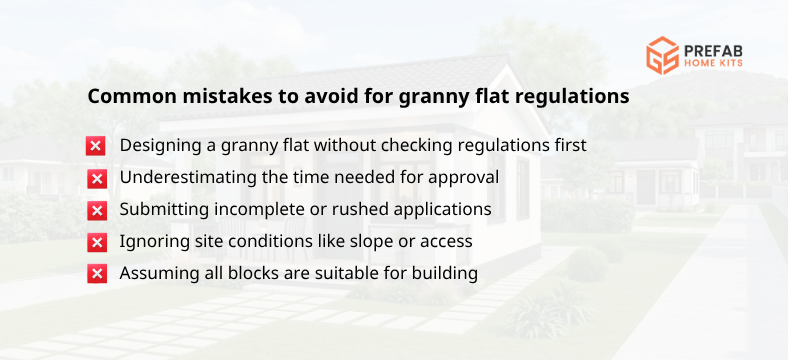
Many delays and issues with granny flat projects come from simple mistakes.
One common mistake is designing a granny flat without checking regulations first. This can lead to plans that need to be changed or even rejected.
Another mistake is underestimating how long the approval process can take. Rushing this stage often leads to incomplete applications and delays.
Ignoring site conditions is also a problem. Even if your design meets regulations, your land still needs to be suitable for construction.
Avoiding these mistakes can make the entire process smoother and more efficient.
How to Make Regulations Easier to Manage
While granny flat regulations may seem complex at first, they become much easier to handle with the right approach.
Start by understanding the basic rules for your area. Then, choose a design that fits within those guidelines as closely as possible.
Working with professionals who have experience in granny flat projects can also make a big difference. They can help you prepare the right documents, meet requirements, and move through the approval process more smoothly.
Taking the time to plan properly will save you time and money in the long run.
Final Thoughts
Understanding granny flat regulations is a key step in building a successful project. These rules are there to ensure your granny flat is safe, legal, and suitable for your property.
While there are several requirements to consider, most of them are straightforward once you know what to look for. By checking the rules early, planning carefully, and choosing the right design, you can avoid common issues and move forward with confidence.
A well-planned granny flat that meets all regulations is not just easier to build—it’s also more valuable and more enjoyable to use in the long term.
Get a FREE quote for a granny flat here.
Explore more ideas at our Prefab Home Kits Fanpage.