Is a Granny Flat Cheaper Than Buying a House?

If you’re trying to get into the property market or simply need more space, you’ve probably asked yourself this: is building a granny flat actually cheaper than buying a house?
The short answer is yes — in most cases, a granny flat is significantly more affordable. But the real answer depends on your situation, your goals, and how you plan to use the space.
This guide breaks it down in simple terms so you can clearly see the cost differences, the pros and cons, and which option might suit you better in Australia.
Understanding the Cost Difference
At a basic level, the biggest difference between a granny flat and a house comes down to scale and land ownership.
When you build a granny flat, you’re usually adding it to land you already own. When you buy a house, you’re paying for both the land and the property itself.
Typical cost comparison in Australia
| Option | Estimated cost | What you’re paying for |
| Granny flat | $100,000 – $200,000 | Build only (on existing land) |
| House (entry-level) | $500,000 – $900,000+ | Land + full property |
This gap is why many Australians are turning to granny flats as a more accessible option.
Why a Granny Flat Is Usually Cheaper
A granny flat costs less for several practical reasons. It’s not just about size, it’s about what you’re not paying for.
Land is one of the most expensive parts of buying a house. In many areas, it makes up a large portion of the total price.
With a granny flat, you skip that cost entirely if you’re building in your backyard. That alone can save hundreds of thousands of dollars.
Smaller Size Means Lower Build Cost
A granny flat is much smaller than a standard house, and this has a direct impact on cost. Because of the reduced size, you naturally spend less on materials, require less labour, and complete construction faster. Most granny homes in Australia sit around 40–60 square metres, which is significantly smaller than a typical house. This smaller footprint is one of the main reasons why a granny flat is far more affordable to build.
Lower Upfront Financial Pressure
Buying a house usually comes with a heavy financial commitment from the start. You need to prepare for a large deposit, ongoing mortgage repayments, stamp duty, and legal fees. These costs can add up quickly and create long-term financial pressure. In contrast, building a granny flat removes many of these barriers. If you already own land, you can avoid paying for land altogether and may even fund the build through savings or equity, making it a more manageable option.
But Is It Always the Cheaper Option?
While a granny flat is generally cheaper upfront, it is not always the best financial decision in every situation. The right choice depends on your personal circumstances, long-term goals, and how you plan to use the property.
When buying a house might make more sense
There are situations where purchasing a house may offer better value over time, especially if your needs go beyond what a granny home can provide.
You don’t own land
If you do not already own land, building a granny flat becomes much less practical. You would first need to purchase land, which removes one of the biggest cost advantages. In this case, buying a house may be the more straightforward option.
You want full independence
A granny flat is typically built on the same block as the main house, which means you are sharing land. This can reduce privacy and may come with certain restrictions depending on local regulations. If having your own space and independence is important, a separate house may be more suitable.
You’re thinking long-term capital growth
While a granny flat can increase property value, standalone houses on separate titles often perform differently in the long term. In strong markets, houses may experience higher capital growth compared to properties with granny flats. If your main goal is long-term investment growth, this is an important factor to consider.
Ongoing Costs: Granny Flat vs House
It’s important to look beyond the upfront cost and consider ongoing expenses as well. A granny flat is generally cheaper to maintain because of its smaller size and lower energy usage.
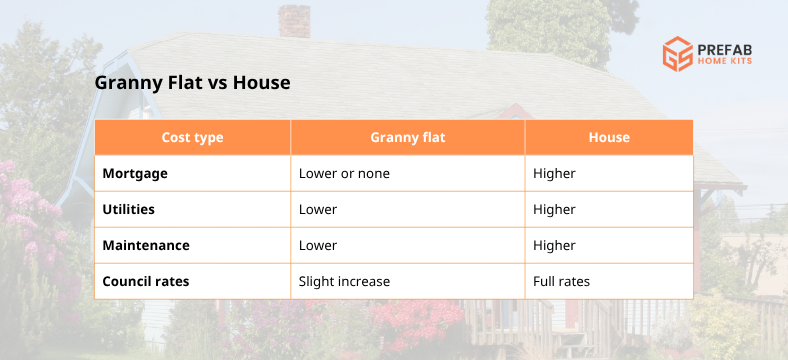
Overall, a granny home places less financial pressure on you over time, especially if you are trying to keep ongoing costs low.
Read more: How Much Does a Granny Flat Cost in 2026?
Rental Income Potential
One of the biggest advantages of building a granny flat is the opportunity to generate rental income. This can turn your investment into a steady source of cash flow.
How a granny flat can pay for itself
If you choose to rent out your granny home, it can typically generate between $250 and $600 per week depending on location and quality. Over time, this income can help cover the cost of construction and even provide additional profit, making it a practical financial strategy.
Compared to buying a second house
Buying a second house for rental purposes usually requires a much larger loan and comes with higher risk and ongoing costs. In comparison, a granny flat offers a more accessible way to enter the rental market. With a lower upfront investment and reduced financial pressure, it is often seen as a safer option for many Australians.
Lifestyle Considerations
Cost is only one part of the decision. Your lifestyle and how you plan to use the space are just as important when choosing between a granny flat and a house.
Benefits of a granny flat
A granny flat offers a high level of flexibility that can suit different stages of life. It can be used as a living space for aging parents, accommodation for adult children, a guest house, or even a home office or studio. This flexibility means your granny home can adapt to your needs over time, making it a versatile addition to your property.
Limitations to consider
Despite its benefits, there are some trade-offs to keep in mind. A granny flat provides less space compared to a house, which may not suit larger households. Privacy can also be limited since it is usually located on the same block as the main home. In addition, local council regulations may restrict how the space can be used. These factors should be carefully considered before making a decision.
Build Time: Faster and Simpler
Another major difference between a granny flat and a house is how long it takes to complete the process.
Granny flat timeline
A granny flat can typically be built within 10 to 16 weeks, especially if you choose a prefab or simple design. This makes it a quick solution if you need extra space in a short time.
Buying a house
Buying a house often takes longer. The process can include weeks or months of searching, followed by settlement periods and sometimes renovations after purchase. This makes it a slower option compared to building a granny home.
Flexibility and Control
When you build a granny flat, you have more control over the final result. You can decide on the design, layout, materials, and budget based on your needs. This allows you to create a space that fits your lifestyle more closely.
In contrast, buying a house usually means choosing from existing properties. While you can renovate later, this often adds extra cost and time. For many people, the ability to customise a granny home from the start is a major advantage.
Financial Risk Comparison
The level of financial risk is another key difference between the two options.
Granny flat
A granny flat generally involves a lower upfront investment and, in many cases, little to no additional debt. This makes it easier to manage financially and reduces exposure to interest rate changes. For many people, it feels like a safer and more controlled investment.
House
Buying a house usually requires a larger loan, which means a long-term financial commitment. Mortgage repayments can be affected by interest rate changes, and the overall financial pressure is higher. While it may offer strong long-term growth, it also comes with greater risk.
When a Granny Flat Is the Better Choice
A granny flat is often the better option if you already own land and want to make use of it without a large investment. It also suits those looking for a lower-cost build, a way to generate rental income, or a flexible living space that can adapt over time.
When Buying a House Is Better
Buying a house may be the right choice if you want full independence and do not want to share land. It is also more suitable if you do not already own property, if your focus is on long-term capital growth, or if you need a larger living space for your household.
Final Thoughts
So, is a granny flat cheaper than buying a house?
In most cases, it is significantly cheaper. A granny flat allows you to create extra living space or income without the high cost of purchasing a new property.
However, the right choice depends on your situation. A granny flat is ideal if you already own land and want a cost-effective, flexible solution. Buying a house may be better if you need independence or are focused on long-term investment growth.
The key is to look beyond just the price and consider how each option fits your lifestyle, financial goals, and future plans.
If you plan carefully, a granny flat can be one of the most practical and affordable ways to expand your living space in Australia.
Get a FREE quote for a granny flat here.
Explore more ideas at our Prefab Home Kits Fanpage.