What Is a Granny Flat? Everything You Need to Know in Australia
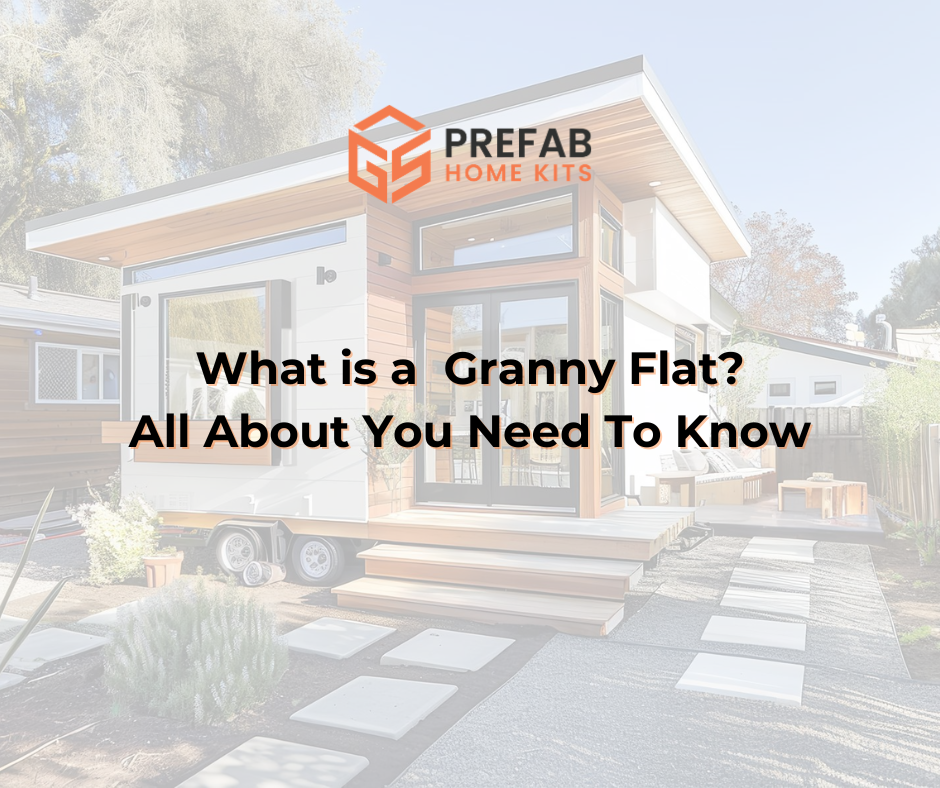
The term “granny flat” became popular because they are often built by families wanting a separate, home-like dwelling for family members, especially elderly parents, or to add a cozy area for long-term visitors. Over time, it has become a popular addition to family homes and is favored by real estate investors to maximize returns on their properties.
But what exactly are they? While many people think they know what a “granny flat” is, it’s a rather vague term and needs a clearer definition. In this article, Prefab Home Kits will tell you what they are, how to use them, and whether you can build one on your land.
How did granny flats originate, and what was their original use?
Granny flats were first introduced during the Victorian era, small, self-contained homes built on large estates for widows (often called “widow homes” or “dow homes”), typically consisting of one bedroom, a small kitchen, a living room, and a bathroom.
Over time, as estates were divided into smaller suburban lots, these small homes shrank and moved closer to the main house, gradually evolving into what we now call “granny flats.” These modern serve a similar purpose: providing accommodation for elderly relatives who are no longer able to live alone.
For a time, granny flats fell out of favor and only began to reappear in the early 21st century. With the current housing crisis and an aging population, this is the optimal solution that even state and federal governments have embraced to address the growing housing demand.
What is a granny flat?
A granny flat is a small, self-contained living space built on the same plot of land as the main house. It can be a converted attic, basement, garage, or even a separate area from the rest of the house.
These homes are often designed for elderly relatives or other family members who want to live independently but still remain close to the family. Recently, they have also been used for financial purposes, such as rental income.
Types of Granny Flats
Granny flats can take many different forms, depending on space, budget, house style, and how you plan to use them. Some are created by converting existing parts of a house, such as a garage or basement. Others are new constructions.
Converted Structures
One of the most common and cost-effective ways to create a granny flat is to renovate existing spaces in a house. This could involve transforming a basement, garage, or attic into a standalone living space.
These renovations increase property value affordably and sustainably by relying on existing architecture rather than building from scratch.
New constructions
New build granny flats are another option if your home doesn’t have enough space for renovation, but you instead have additional land. These units can be custom-designed or prefabricated, giving you a wide range of layout and design choices.
Types of new structures include:
- Detached Granny Flats: Independent structures in the backyard or elsewhere on the property. They offer maximum privacy and independence.
- Attached Granny Flats: Built as extensions of the main home, sharing at least one wall, often with separate entrances. They offer a good balance between proximity and independence.
- Prefab/Modular Granny Flats: Prefabricated modules built off-site and installed on your property, significantly reducing construction time.
Granny Flats Amenities
Are designed to be self-contained, so it typically includes a kitchen, bathroom, bedroom, and at least one living area.
- Private Living Space: A senior home is equipped with private living spaces such as a living room and bedroom, or it may be arranged as an open-plan studio apartment.
- Kitchen Amenities: Fully equipped, from a stovetop to a microwave and mini-refrigerator.
- Bathroom Amenities: A private bathroom including a shower, sink, and toilet.
- Laundry Amenities: A senior home may have laundry facilities or share them with the main home.
- Other Features to Help Care for the Elderly: such as handrails in the bathroom and smart technology like voice-controlled lighting and heating, remote health monitoring, and automated assistance.
In general, this is what a small apartment for seniors usually looks like – however, you might consider using a few clever design tricks to change the traditional building layout!
Cost to Add a Granny Flat
In Australia, a basic, it costs between $80.000 and $125.000 for a one-bedroom unit, with two‑bed units often $150.000 – 250.000+ once permits, site work, and finishes are included. The final price will depend on the size of the unit, whether it’s a converted or a new structure, materials used, and local labor costs.
Prefab or kit granny flats can be cheaper, roughly $70.000 – 150.000, depending on size and inclusions, because much of the work is done off‑site.
Explore our detailed guide on Prefab granny flats
Factors Affecting Costs
- Size and Layout
- Building Materials
- Site Conditions
- Labor Costs
Hidden Costs
When budgeting for a detached house construction in Australia, it’s important to consider additional costs such as:
- Local Council Fees and Permits
- Utility Connections (Water, Electricity, Drainage)
- Design and Architectural Services
To better understand the costs involved, you can read our detailed guide on Cost of Building a Granny Flat.
Pros and Cons of Granny Flats
Like any property investment, this type of house in Australia comes with both advantages and disadvantages.
Pros
- Generates additional income
- Increases property value
- Flexible use (family or rental)
- Lower cost compared to buying a new property
Cons
- Initial construction cost
- Regulatory limitations
- Potential privacy concerns
- Ongoing maintenance
The Future of Granny Flats in Australia
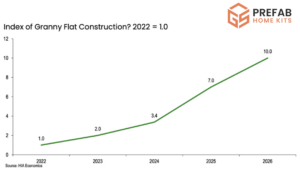
A survey of builders regarding granny flat construction reveals a potential boom across Australia in the coming years, with predictions that the number of them built by 2026 will be 10 times that of 2022.
Following the success of NSW’s new “granny” housing concept, Western Australia announced changes in January 2024, which removed the requirement to get planning approval for a compliant granny house up to 70 square metres. It also scrapped the previous minimum lot size requirement of 350 square metres.
According to Domain’s data, the search term ” Granny Flat” was the most searched keyword in Sydney, with a 3.1% increase. Additionally, it also ranked among the top 10 most searched keywords in Perth (+59.8%) and Adelaide (+24.4%).
Why choose to build a Granny Flat?
The benefits of choosing this type of home are numerous – especially in WA and the surrounding areas!
- Simple process: The average time to design and complete construction is only about 12-16 weeks.
- Increased property value: A well-designed small apartment, regardless of its use, can increase your property value.
- Flexibility: Can be used as a family ( elderly parents, other members), studio, guest accommodation, or even a short-term rental.
- Capital Gains Tax (CGT) exemption.
- Environmental benefits: Smaller living spaces often mean lower electricity and water consumption and less carbon emissions.
Compared to buying a new house or a new plot of land to build on, building a granny flat is a more economical way to expand living space. It helps address the housing shortage in urban areas.
Overall, granny flats in Australia offer both lifestyle benefits and high financial returns, making them attractive to both homeowners and investors.
Can I build a granny flat on my property?
Yes – but that depends on a few key factors. You can build a duplex if you meet the following requirements:
- Have enough space on your land for an additional housing unit
- Have sufficient budget for construction,
- Check local planning laws and confirm that duplex housing is permitted in your area
- Obtain the necessary permits to ensure your project complies with building regulations
Ready to get started on your granny flat? The next step is planning your layout – see our article Granny Flat Floor Plans To Inspire Your Build for design ideas.
Key Takeaways
What is a granny flat? It’s a small, self-contained living space (with kitchen, bathroom, bedroom, etc.) located on the same plot of land as the main house.
Purpose: Initially for elderly relatives, now also used for rental and income generation.
Main types:
- Renovated from existing spaces (garage, basement, etc.)
- New construction (detached, attached, prefab/modular)
Cost in Australia: Approximately $80,000 – $250,000+, depending on the type; prefabs are usually cheaper; additional hidden costs such as permits and utility connections, need to be considered.
Advantages: Increases property value, generates income, flexible use, lower cost than buying a new home.
Disadvantages: High initial cost, limited by regulations, privacy issues, and maintenance.
Future trends: Strong demand due to the housing crisis and aging population; relaxed policies (like in WA) will boost development.
Investment benefits: An optimal solution for maximizing profits and efficient land use.
Construction requirements: Depend on land area, budget, local regulations, and permit application process.
Final Thoughts
Understanding the details of a granny flat is essential for anyone considering this addition. There’s no single “best” type of property, only the one that best suits you. Whether you choose to build a detached house, a prefabricated house, or simply convert structures, each type has its own advantages.
It’s crucial to focus on space utilization, budget, the right needs, and the load-bearing capacity of the home. With the right choice, a small apartment for seniors can become one of the most practical and valuable additions to your home, offering both flexibility and long-term benefits.
If you need more detailed information or have any questions, please contact us below.
Get a FREE quote for a granny flat here.
Explore more ideas at our Prefab Home Kits Fanpage.